

Healthy Leadership: How Leaders Can Strengthen Their Own and Their Team’s Mental Health
This article is also available in German.
Mental health issues have been rising steadily in recent years, with noticeable effects on employees, organizations, and leaders alike. Yet the workplace can be part of the solution rather than just part of the problem. Leaders who learn to manage their own wellbeing and actively practice healthy leadership lay the foundation for sustainable mental health at work.
Mental Health: A Growing Challenge for Organizations
Mental health conditions are now among the most common health problems of our time. Research shows that a significant portion of the population experiences depression, anxiety disorders, or substance-related disorders at least once in their lifetime. In Switzerland, between 20 and 40 percent¹ of people meet the criteria for a depressive episode at some point, and roughly one in four experiences an anxiety disorder.
These developments have tangible consequences for organizations. Mental health-related absenteeism tends to be prolonged: on average, affected employees are absent from work for over 200 days². In the canton of Zurich alone, illness-related absences cost billions annually. Younger employees aged 18–29 are particularly affected, experiencing high levels of psychological strain.
Small and medium-sized enterprises (SMEs) are also significantly impacted. Recent surveys show that almost two-thirds of SMEs have already faced mental health-related absences. The proportion of heavily affected organizations continues to rise, while over 30 percent³ of employees report emotional exhaustion—a key risk factor for burnout. These figures highlight that mental health is no longer a peripheral issue but a central leadership responsibility.
The Workplace as a Risk Factor — and an Opportunity
We spend about one-third⁴ of our lives at work, making the influence of working conditions on wellbeing considerable. High workload, limited autonomy, and unclear roles can intensify stress and, over time, harm health.
At the same time, work offers tremendous potential for meaning, social connection, self-efficacy, and personal growth. The key factor is how well a person fits their job — a concept known as the job-person match⁵. When work aligns with individual strengths, interests, and resources, it can even protect against exhaustion and burnout.
This is where leaders play a crucial role, as they shape how work is organized for themselves and for others.
Healthy Leadership Starts with Self-Leadership
Healthy leadership toward others requires first leading oneself effectively. Put simply, leaders who want to remain capable and resilient must learn to manage their own resources consciously.
Self-leadership involves recognizing personal needs, setting boundaries, and actively developing strategies to cope with mental demands. It is about managing effectiveness not through constant overexertion, but through sustainable energy management.
Three effective approaches include:
1. Strengths-Based Job Crafting
Strengths-based job crafting means actively adapting one’s work to better match personal strengths and interests. This can involve:
- Adjusting the intensity with which tasks are performed,
- Changing the way tasks are carried out,
- Deliberately shaping work relationships, or
- Reinterpreting one’s role.
Even small adjustments can increase meaning, motivation, and energy in daily work.
2. The Activation of Positive Resources
A simple yet powerful method is the Three-Word Induction. Here, three keywords associated with a personally experienced positive situation are identified. These words serve as mental anchors, allowing leaders to recall associated feelings—such as safety, calm, or courage—during challenging moments.
3. Active Stress Management
Regular breaks, intentional recovery, and reflective handling of stressors are essential for long-term health. It can be particularly useful to map stress and recovery phases across typical work and free days, analyzing when high stress, energizing challenges, or rest occur and identifying opportunities for better time management
Healthy Leadership: Supporting Others’ Health
Beyond self-leadership, guiding others’ wellbeing is a key component of Healthy Leadership. It involves creating conditions that promote health and responding sensitively to signs of stress.
The concept of Healthy Leadership developed by Stephan Böhm and colleagues distinguishes between two levels: prevention and intervention.
Prevention: Acting Before Problems Arise
Leaders can help employees avoid reaching a state of strain by:
- Ensuring a realistic workload,
- Prioritizing tasks clearly,
- Demonstrating openness about their own limits.
When leaders model openness regarding stress, employees are more likely to voice challenges themselves.
Intervention: Supporting When Strain Appears
If employees show signs of mental strain—such as concentration difficulties, changes in social behavior, or irritability — leaders should act sensitively but proactively. Key steps include:
- Communicating that employee health is a priority,
- Initiating open dialogue and listening,
- Collaboratively developing solutions, such as adjustments to working hours, task volume, or responsibilities.
A recent CCDI-HSG study⁶ shows that such supportive leadership interventions are linked to lower rates of illness-related absenteeism.
Healthy Leadership as a Strategic Success Factor
Mental health in the workplace is one of today’s major challenges, and leaders play a pivotal role—not only in how they treat others but also in how they manage themselves.
Leaders who strengthen their own resources, shape work meaningfully, and remain attentive to their team’s needs create environments that foster health rather than undermine it.
Healthy Leadership starts with a simple insight: healthy organizations require healthy leaders.
Want to learn more about how to put Healthy Leadership and effective self-leadership into practice?
Healthy Leadership Training | Job Crafting
Sources
¹ Nationaler Gesundheitsbericht 2025 | Obsan. (o. D.). https://gesundheitsbericht2025.ch/
² Meyer, M. & Obrist, H. (2025, 3. Juni). Ausfall am Arbeitsplatz: So viel kosten psychische Erkrankungen die Zürcher Wirtschaft. Tages-Anzeiger. https://www.tagesanzeiger.ch/ausfall-am-arbeitsplatz-so-viel-kosten-psychische-erkrankungen-die-zuercher-wirtschaft-564814469845
³ AXA Studie: 64 Prozent aller KMU sind von psychisch bedingten Ausfällen betroffen. (o. D.). AXA Schweiz | KMU-Studie 2023: Psychisch Bedingte Ausfälle. https://axa.ch/de/ueber-axa/medien/medienmitteilungen/aktuelle-medienmitteilungen/2023/20231009-kmu-studie-absenzen-psychische-gesundheit.html
⁴ Arbeitsbehörde, E. (2024, 4. April). Die richtige Balance zwischen Arbeitszeit und persönlicher Zeit finden. EURES (EURopean Employment Services). https://eures.europa.eu/striking-right-balance-between-work-and-personal-time-2024-04-05_de
⁵ Leiter, M. P., & Maslach, C. (2004). Areas of worklife: A structure approach to organizational predictions of job burnout. In P. L. Perrewé & D. C. Ganster (Eds.), Emotional and physiological processes and positive intervention strategies: Research in occupational stress and well-being (Vol. 3, pp. 91–134). JAI Press.
⁶ Boehm, S. A., Khademi, M., & Baumgaertner, M. K. (2026). From relation to intervention: how supervisors’ health-focused intervention behavior relates to employees’ sickness absenteeism. European Journal of Work and Organizational Psychology, 1-22. https://doi.org/10.1080/1359432X.2025.2606717

This might interest you
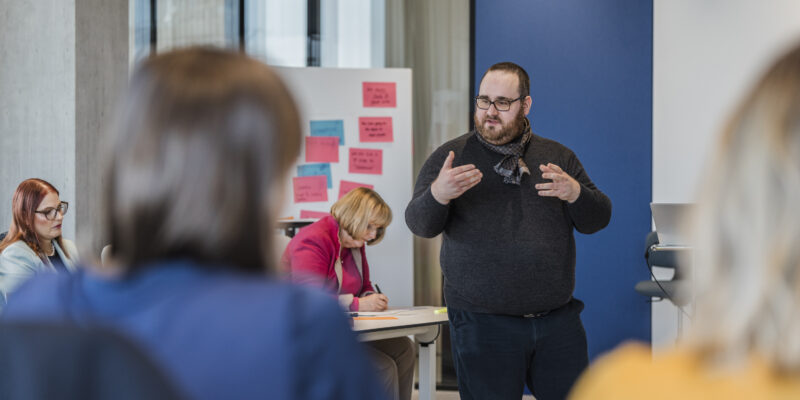
Team Job Crafting: Recognising potential, jointly shaping team goals
Designing work tasks and job profiles based on individual strengths is essential to make the best use of employees' capabilities. However, in the day-to-day work it is often not possible to fully implement this approach for every team member at all times. Our team job crafting workshop is designed to support leaders and their teams to jointly identify and actively shape as much crafting potential as possible.