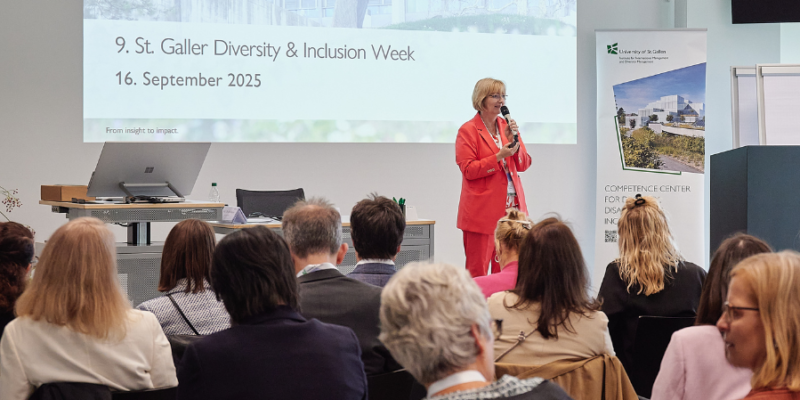
What began as an idea to showcase the diverse expertise at HSG now attracts more than 1,000 participants each year. To mark the anniversary, Gudrun Sander reflects on the beginnings of D&I Week, the changing challenges in the world of work, and the questions organisations will need to address in the future.
The Beginning – Why did you start D&I Week?
Thirty years ago, the topics I was working on made me something of an outlier at HSG. Then, around ten years ago, I realized that something had changed: there were now many colleagues across HSG working in these fields – conducting research, developing exciting practice-oriented projects, and much more.
Yet HSG was not primarily known for its expertise in diversity and inclusion. I wanted to change that. So I launched the on-site event “D&I Tagung” – which later became D&I Week – as a platform to showcase the many different initiatives and activities across Diversity, Equity & Inclusion.
Taking the Leap – What was the biggest challenge at the time?
The biggest challenge when we first launched the conference was funding. However, I managed to secure support from a small number of sponsors, along with a modest deficit guarantee from HSG’s School of Management. This allowed us to hold our first conference on 12 September 2017.
The programme was incredibly diverse, and it was easy to get colleagues excited about contributing. Everyone brought their best research and practice projects, which allowed us to set a very high standard right from the start.
I particularly enjoyed our so-called “Querdenker Session”, where Thomas Geiser and Christa Binswanger (pictured) discussed whether there is actually a need for an officially registered gender. Another highlight was welcoming 150 participants to our very first event. We were also fortunate to have a strong organizing team that built and promoted the conference with great enthusiasm.
The Shift – How has the world of work changed?
Over the past ten years, we have seen two very different developments. Between 2022 and 2024, interest in topics such as inclusion, the better integration of minority groups, and equal opportunities grew significantly. One of the main drivers was the shortage of skilled professionals and managers, which became particularly acute during this period. We still see this shortage in some sectors today, such as healthcare.
The geopolitical upheavals of the past two years and rapid developments in artificial intelligence have created considerable uncertainty and economic challenges, shifting some of the attention away from topics such as talent management. Today, many companies are being flooded with applications, whereas at the beginning of 2024 they were struggling to fill open positions.
At the same time, new questions are emerging: What impact will AI have on occupations and career paths traditionally associated with women and men? How can competency-based employee development be implemented effectively?
As organizations increasingly focus on employees’ skills and potential, inclusion remains highly relevant, even if topics such as representation seem to have moved into the background. At the same time, AI is increasing the pressure on already vulnerable groups.
The Surprise – What did you never expect?
I never expected that COVID would lead to such a dramatic increase in participation. The pandemic forced us to move the event online. From 7–11 September 2020, after three years of traditional conferences with around 150 participants, we held our first online edition, with ten sessions spread across the week.
Over those five days, we reached a total of 737 participants interested in diversity, primarily from Switzerland, Germany, and Austria.
That was the beginning of a new hybrid concept. In the years that followed, we continued to develop the format, combining an on-site conference with free online sessions throughout the week. Today, D&I Week reaches more than 1,000 participants every year.
Speakers 10. D&I Week
The Headwinds – How do you deal with criticism or the DE&I backlash?
I take criticism very seriously and try to listen carefully. Ultimately, critical voices give us an opportunity to learn.
I have mixed feelings about the current DE&I backlash. A strong economy and a well-functioning public sector depend, among other things, on engaged employees. People are more likely to engage when they are treated fairly and taken seriously, and when they are seen and supported as individuals. These are all fundamental aspects of DE&I.
For this reason, I continue to see inclusion as highly relevant for organizations. Do we have the right people with the right skills and potential in our organization? How do we support their development?
High-quality HR processes and reflective leadership are far more than a “nice to have”. The backlash may also be pushing us to reframe DE&I, use simpler and more accessible language, and focus our efforts where they can have the greatest impact. This may ultimately help us advance the core objectives of DE&I more effectively.
The Impact – What are you most proud of?
I am incredibly proud that we have succeeded in establishing D&I Week as THE event for diversity and inclusion in Switzerland.
For ten years, we have stood for quality, evidence-based projects, cutting-edge research, and meaningful exchange between academia and practice as equal partners. That is something I am extremely proud of.
The Advice – If companies today should avoid just one mistake in how they approach Diversity, Equity & Inclusion, what would it be? And what would you recommend instead?
Delegating the topic entirely to a diversity officer. It simply does not work.
At its core, DE&I is about cultural change and improving the quality of organizational processes and structures. Everyone has a role to play and needs to contribute within their own sphere of influence – but leaders in particular have a crucial responsibility.
That does not mean organizations do not need DE&I experts. I often compare it to finance: every leader needs a basic understanding of finance and financial management in order to lead successfully. Finance experts support leaders and provide them with the information they need to make sound decisions. Ultimately, however, responsibility remains with the leaders.
The same principle applies to DE&I.
The Future – What will be needed over the next ten years?
We need to engage in dialogue with different stakeholders and move beyond awareness towards concrete action with measurable impact.
In many areas of our work, robust impact measurement is still lacking. What really makes the difference in whether new employees feel a sense of belonging during onboarding? What kind of leadership development actually helps create a climate of trust in everyday working life? Which measures genuinely improve the retention of specific groups within an organization?
These are the kinds of questions we need to focus on in the years ahead.
The Legacy – What would you like to pass on to the next generation?
Take nothing for granted.
This applies to achievements such as legal equality just as much as to persistent resistance and enduring myths – for example, the idea that women do not want to lead or play an active role in shaping organizations and society.
It is important that we remain vigilant and continue to stand up for what matters to us: equal opportunities and democracy.
Interview: Natascia Leotta
The 10th St. Gallen Diversity & Inclusion Week will take place from 14 to 18 September 2026. The on-site conference will be held on Tuesday, 15 September 2026. Further information is available on our website: St.Gallen Diversity & Inclusion Week.
People
Prof. Dr. Gudrun Sander
Prof. Dr. Gudrun Sander is titular professor of business administration with a special focus on diversity management, director of the Competence Center for Diversity, Disability and Inclusion, and director of the Insitute for International Management and Diversity Management. She researches diversity and inclusion issues from the perspectives of strategy, leadership and corporate culture, leads the national diversity benchmarking and is an academic expert in various international and national committees.